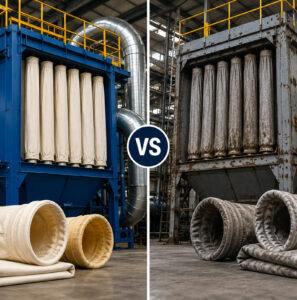
High Temperature Filter Bags vs Traditional Methods: Which Performs Better?
At 2 a.m., when a boiler temperature climbs and the…
Read More →

A high-temperature filter bag can look perfect on delivery and still be wrong for the process. The 2026 high temperature filter bags checklist is not a shopping list; it is a risk-control tool. Before approval, confirm the gas temperature, chemical exposure, moisture, dust behaviour, baghouse design, cleaning method, cage condition, installation plan, monitoring routine, and supplier evidence. These 25 checkpoints help plants prevent premature failure, unstable pressure, emissions, and repeat shutdowns.
Use logged operating data, not a single control-room reading. Record normal temperature across shifts, production rates, fuels, and seasons.
Document the highest spike, duration and frequency. A short surge rating must never be treated as the normal operating limit.
Select media with room below its recommended limit. ClipOn lists aramid around 204°C and fiberglass, P84, and PTFE options up to 260°C for boiler applications. Final suitability still depends on the complete process.
Identify when gas may cool enough to condense. Startups, shutdowns, air leakage, and wet fuel can turn dry dust into sticky, corrosive deposits.
Measure acids, alkalis, oxygen, solvents, sulphur compounds, and reactive components. Heat resistance does not automatically mean chemical compatibility.
Fine particles behave differently from coarse dust. Confirm whether the media, membrane, and dust cake delivers required capture performance.
Hard mineral, metal, ash, and cement particles can cut fibres near inlets or cages. Consider pre-separation, inlet protection, and abrasion-resistant construction.
Hygroscopic, oily, or wet dust may cling to fabric and resist cleaning. Surface treatments should solve a defined problem, not decorate a specification.
Where combustible dust exists, evaluate grounding, conductive construction, explosion protection, and site requirements with qualified safety specialists.
A good bag cannot compensate for blocked hoppers, failed rotary valves, or material re-entrainment. Include discharge equipment in every inspection.
Compare aramid, PPS, P84, fiberglass, and PTFE against temperature, chemistry, moisture, abrasion, and cleaning stress not price alone.
Confirm whether singeing, glazing, hydrophobic, oleophobic, acid-resistant, or ePTFE treatment is required. Check that every finish shares the needed thermal tolerance.
The felt is only one component. Scrim, thread, seams, cuffs, and reinforcement can become the weakest point under heat.
Verify diameter, length, cuff, bottom style, seam position, and tube-sheet fit from approved drawings, not an old purchase order.
Inspect welds, corrosion, wire spacing, geometry, and surface finish. ClipOn supplies custom cage materials and constructions intended to support bags without damaging contact.
Keep bags dry, covered, stacked, and protected from sunlight, chemicals, sparks, and unnecessary handling before installation.
Use clean gloves and tools. Never drag, twist, crush, or force bags into place, especially when handling less-flexible fiberglass media.
Check snap bands, cuffs, clamps, venturis, and neighbouring clearances. One poor seal can create dust bypass despite good media.
Prevent dirty gas from reaching cold bags to prevent condensation. Define startup responsibilities instead of relying on operator memory.
Record clean-system differential pressure, airflow, temperature, cleaning settings, and visible condition. Troubleshooting needs a reliable baseline.
Do not depend on one reading. A rising trend may indicate blinding or weak cleaning; a sudden drop may suggest leakage or damaged media.
Check pulse valves, pressure, duration, sequencing, compressed-air quality, and reverse-air or shaker operation. More aggressive cleaning is not always better.
Record every alarm, duration, process cause, and corrective action. These records are among the most valuable high temperature filter bags tips for failure analysis.
Label removed bags and record their compartment and row. Repeating damage near an inlet, cage wire, or cuff reveals causes that random replacement hides.
Compare service life, fan energy, maintenance hours, emissions, replacements, and downtime. High temperature filter bags best practices measure operating value, not unit price.
A checklist creates value only when engineering, operations, maintenance, safety, and purchasing use the same version. Attach process data, approved drawings, material certificates, inspection reports, baseline readings, and failure photographs. Review it after fuel changes, production increases, baghouse modifications, or unusual temperature events.
For corrosive, moisture-sensitive, and severe high-heat conditions, review ClipOn’s PTFE filter bags and share your operating temperature, gas chemistry, dust characteristics, dimensions, and cleaning method before choosing a construction. ClipOn PTFE bags can withstand continuous temperatures up to 260°C and peaks up to 300°C in appropriate conditions.
At 2 a.m., when a boiler temperature climbs and the…
Read More →What happens when filtration engineers, boiler operators, and maintenance leaders…
Read More →
High-temperature filter bags rarely fail because of one dramatic event.…
Read More →