The 2026 High Temperature Filter Bags Checklist: 25 Must-Have Elements
A high-temperature filter bag can look perfect on delivery and…
Read More →

A baghouse problem rarely belongs to one department. Operations sees rising pressure, maintenance finds damaged cages, safety watches emissions, and purchasing receives an urgent request for replacements. Building a filtration team means bringing those clues together. To organise high temperature filter bags step by step, appoint one accountable leader, assign technical and operational roles, create a shared process record, define decision gates, and review performance. The goal is not a larger committee. It is a team that can turn scattered evidence into faster and better filtration decisions.
Begin by appointing one filtration lead to own the workflow from problem definition to post-installation review. The lead schedules meetings, requests missing data, records decisions.
Choose someone who can speak with operations, maintenance, engineering, environmental teams, and suppliers. Without ownership, temperature logs stay in one system, failed bags disappear into waste bins, and purchase orders repeat old specifications.
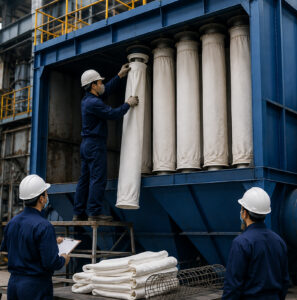
Keep the group compact. Assign a process owner who understands fuels, production changes, gas flow, and startup behaviour. Add a filtration engineer to evaluate media, finishes, dimensions, and cleaning design. Include a maintenance representative who handles cages, pulse valves, hoppers, seals, and installation quality.
An environmental or safety specialist should connect baghouse performance with outlet monitoring. A procurement partner should compare technical scope, traceability, delivery, and lifecycle value rather than unit price alone. Appoint a data coordinator to maintain drawings, temperature histories, pressure trends, inspection photographs, and failure records.
Each responsibility must remain visible.
The team’s first deliverable is not a material recommendation. It is a verified process passport containing normal temperature, continuous maximum, peak temperature, spike duration, gas chemistry, moisture, dew-point risk, oxygen, airflow, dust loading, particle behaviour, cleaning method, and equipment dimensions.
ClipOn identifies fiberglass, P84, aramid, and PTFE for demanding boiler filtration, with stated temperature capabilities varying by material. Chemistry, abrasion, moisture, and operating duration decide suitability.
A shared passport prevents each supplier from quoting against different assumptions.
Create four decision gates. Gate one confirms that process data is complete. Gate two approves the media and construction logic. Gate three verifies cages, drawings, quality documents, installation method, and startup plan. Gate four accepts performance after trend data and inspection evidence are reviewed.
High temperature filter bags tips should become gate questions. What is the acid dew point? How often do temperature excursions occur? Where did previous bags fail? Does cleaning pressure recover airflow or simply stress the fabric?
Operations should track temperature, production conditions and events. Maintenance should trend differential pressure, cleaning frequency, hopper performance, and failure locations. Environmental teams should review outlet particulate readings, opacity, or bag-leak signals.
The EPA notes that fabric filters generally achieve collection efficiencies above 99 percent and identifies outlet concentration, differential pressure, temperature, gas flow, cleaning operation, and fan current as useful performance indicators.
Procurement should track approved specifications, delivery accuracy, documentation, and repeat failure cost. The team lead should combine these measures into one monthly view.
Do not design the investigation during a shutdown. Write the response in advance. When a bag fails, label its compartment and position, photograph the damage, retain a sample, inspect the matching cage, review recent process events, and compare neighbouring bags.
Assign who can stop the system, who retrieves data, who contacts the supplier, and who approves restart. A ten-minute role drill can expose missing tools, unclear authority, or unavailable records before a real incident.
Choose one compartment, line, or planned replacement as the team’s pilot. Record baseline pressure, temperature, cleaning settings, emissions indicators, cage condition, and installation details. Do not change several variables without documenting them.
For example, if the team changes media, cages, and pulse settings together, performance may improve without revealing why. Controlled changes create learning that can be repeated across the plant.
High temperature filter bags best practices become valuable only when assigned to people and dates. Schedule weekly trend checks, monthly cross-functional reviews, post-startup inspections, and reviews after every excursion or premature failure.
Store the drawing, material data sheet, approved operating window, installation checklist, and failure map in one accessible location. Train backup owners so knowledge survives leave, transfers, and contractor changes.
Filter bags collect particles, but teams protect performance. A well-built group connects operating reality, material science, maintenance evidence, compliance, and purchasing discipline. It notices weak signals before they become stack problems or emergency orders.
Start small: one owner, six defined roles, one process passport, four decision gates, and one shared dashboard. For severe boiler heat, corrosive gases, and abrasive particulate, review ClipOn’s high-temperature boiler filter bag solutions and give the technical team the same verified data your internal team uses. That is how a replacement project becomes a repeatable filtration capability with confidence across future shutdowns.
A high-temperature filter bag can look perfect on delivery and…
Read More → The first warning was not smoke, an alarm, or a…
Read More →
At 2 a.m., when a boiler temperature climbs and the…
Read More →