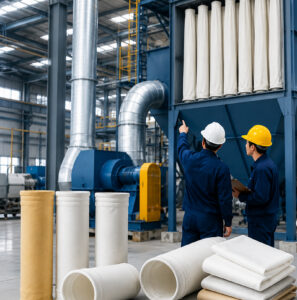
How to Choose the Right High Temperature Filter Bags Agency: A Step-by-Step Guide
Buying a heat-resistant filter bag is not the same as…
Read More →

What does “good” really look like when a filter bag is working under extreme heat? It is not just a high temperature rating on a datasheet. The real answer appears in the numbers: stable differential pressure, controlled emissions, consistent cleaning cycles, fewer failures, and longer service life. In 2026, high temperature filter bags benchmarks help plants separate reliable performance from costly guesswork by showing which operating signals matter, what healthy ranges look like, and when small changes demand attention immediately.
Outlet performance comes first. The US EPA states that fabric filters generally achieve collection efficiencies above 99%, because the accumulated dust cake performs much of the filtration.
However, 99% is not a complete operating target. A plant must compare stack concentration, opacity, or bag-leak readings against its permit, process load, and validated baseline. A stable leak-detector signal can reveal a damaged bag or seal before visible emissions appear.
In 2026, good performance means the plant can answer three questions quickly: What is leaving the stack? Is the reading changing? Which compartment is responsible?
Differential pressure measures resistance across the filter system, but there is no universal “perfect” number. The correct range depends on gas flow, air-to-cloth ratio, media, dust cake, and cleaning design.
Good looks like a repeatable pressure cycle. After cleaning, pressure returns near its established lower baseline. During dust loading, it rises at a familiar rate. Cleaning frequency remains consistent at comparable production.
A slow upward drift may indicate blinding, condensation, oil, weak cleaning, or overloaded hoppers. A sudden fall can suggest a torn bag, failed seal, or bypass. One of the most practical high temperature filter bags tips is to benchmark the shape of the pressure cycle, not merely its highest reading.
A bag should not spend its life touching its limit. ClipOn lists aramid around 204°C, while fiberglass, P84, and PTFE options may reach 260°C. ClipOn’s PTFE has continuous resistance up to 260°C and short peaks up to 300°C.
Those figures describe material capability, not an operating target. Good plants preserve a safety margin, distinguish continuous temperature from surge temperature, and record every excursion by duration and cause.
They also monitor the lower boundary. If gas falls below its moisture or acid dew point, condensation can blind bags and corrode metal components. Thermal excellence therefore means staying below destructive heat and above dangerous condensation.
Imagine a boiler baghouse with these illustrative monthly figures:
These are illustrative, not universal targets. Their value comes from connection. A shorter cleaning interval with unchanged production deserves investigation even when pressure stays inside limits. One failed bag is not “good” if the cause remains unknown. Useful high temperature filter bags examples should expose relationships, not merely decorate a report.
More cleaning does not automatically mean better performance. Excessive pulsing can fatigue fabric, seams, and cages; insufficient cleaning can raise resistance and fan demand.
Good cleaning removes enough cake to restore airflow without stripping the media unnecessarily. Benchmark pulse pressure, valve response, compressed-air quality, cycle frequency, and the pressure recovery after each event. If cleaning frequency rises, inspect dust loading, moisture, pulse valves, hoppers, and airflow before simply increasing pressure.
A well-run system makes fewer emergency adjustments because its normal response is already understood.
Service life matters, but “years in operation” is a weak comparison without context. Temperature, chemistry, abrasion, cleaning energy, airflow, cage condition, and shutdown frequency can make identical bags age differently.
Better benchmarking uses bag failures per operating period, location, mode, and production volume. Record whether damage came from heat, chemical attack, abrasion, cage contact, seam failure, or installation.
Good does not mean no bag will ever fail. It means every failure leaves evidence, triggers root-cause review, and improves the next specification.
By 2026, a strong filtration programme connects five outcomes: compliant outlet emissions, stable pressure behaviour, controlled thermal margins, efficient cleaning, and explainable bag life. It also keeps hoppers, cages, sensors, seals, and maintenance records within the same picture.
The best benchmark is not a competitor’s headline figure. It is a verified baseline that remains stable while production, fuel, or dust conditions change.
Use these high temperature filter bags benchmarks to build a plant scorecard, then review it monthly with operations and maintenance. For media and construction selected around real temperature, chemistry, dust, and equipment data, explore ClipOn’s high-temperature filter bag solutions and speak with the technical team before finalising your specification for dependable performance under demanding industrial operating conditions.
Buying a heat-resistant filter bag is not the same as…
Read More →
A normal filter bag can collect dust efficiently until hot…
Read More →
A filter bag suppliers step by step workflow should automate…
Read More →