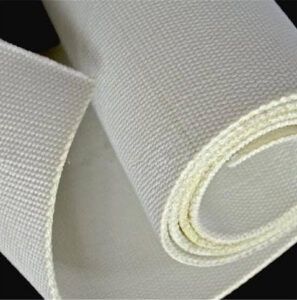
Fluidising Fabrics: How Air Slide Fabrics Improve Powder Flow in Cement Plants
Cement powder can stop a production line without anything “breaking.”…
Read More →

A dust collector can look perfectly sized from the outside and still be working far too hard inside. The clue is often hidden in one simple calculation: the air to cloth ratio. It tells you how much air is being pushed through each unit of filter area. Get that balance wrong and the collector may struggle with high differential pressure, frequent cleaning, shortened filter life, weak dust release, or unstable airflow.
For a baghouse using imperial units:
Air-to-cloth ratio = Actual airflow in ACFM ÷ Total effective filter area in square feet
If a collector handles 12,000 ACFM and has 2,400 square feet of effective cloth area:
12,000 ÷ 2,400 = 5
The air to cloth ratio is therefore 5:1.
That means five cubic feet of actual process air pass through each square foot of filter media every minute.
Do not begin with the fan nameplate unless it represents actual operating flow.
Use the airflow entering the collector under real process conditions. In baghouse calculations, this is commonly expressed as ACFM, or actual cubic feet per minute. “Actual” matters because gas temperature and process conditions affect volume.
A calculation built on the wrong airflow gives you a precise-looking answer that is still wrong.
For cylindrical filter bags, the usable cloth area is based on the circumference and length of each bag.
A practical imperial formula is:
Area per bag = Bag diameter in inches × π × Bag length in inches ÷ 144
Then multiply the result by the total number of bags.
Imagine a collector has 120 bags. Each bag is 6 inches in diameter and 10 feet, or 120 inches, long.
Area per bag:
6 × 3.1416 × 120 ÷ 144 = 15.71 square feet
Total filter area:
15.71 × 120 = 1,885.2 square feet
If the collector handles 9,000 ACFM:
9,000 ÷ 1,885.2 = 4.77
Your calculated ratio is approximately 4.8:1.
Now the important question begins: is 4.8:1 suitable?
This is where simple online explanations can become misleading.
A lower ratio provides more filter area for the same airflow. A higher ratio pushes more air through each square foot of media. But neither “low” nor “high” is automatically good or bad without application context.
Donaldson, for example, sizes collectors using air-to-media recommendations that vary with dust type, loading, operating duty, and collector configuration. Camfil likewise notes that particle characteristics influence the optimal ratio.
So avoid taking one number from another plant and treating it as a design target.
A ratio that works comfortably for one dust may overload another system. Treat manufacturer recommendations, pilot experience, historical pressure trends, and the collector’s cleaning capability as part of the same decision.
An aggressive air to cloth ratio can make filtration harder than it needs to be.
Air moves through the media faster. Dust may become more difficult to release. Differential pressure can rise. Pulse cleaning may trigger more frequently. Filter bags may experience greater mechanical stress, and fine particles can become embedded in the media.
The result can be a collector that technically has enough airflow but operates inefficiently.
Yes, but the interpretation is different.
Adding filter area generally reduces filtration velocity, yet simply making a collector larger is not automatically the most efficient design. Oversizing can increase capital cost, footprint, filter quantity, and maintenance requirements without delivering a proportional operating benefit.
The target should therefore be an appropriate ratio, not the lowest possible number.
The calculation is useful after installation too.
Suppose a plant increases production, adds another extraction point, or changes fan settings. Airflow rises, but filter area stays unchanged. The air to cloth ratio rises with it.
That can explain why a previously stable collector suddenly develops higher differential pressure or shorter filter life.
Recalculate the ratio whenever airflow, production demand, ducting, filter configuration, or collector capacity changes.
A ratio alone cannot select the right filter bag.
Dust particle size, abrasiveness, moisture, oil, gas chemistry, temperature, dew point, dust loading, emissions limits, cleaning pressure, bag spacing, interstitial velocity, and filter media all influence performance.
Two collectors with identical ratios may behave very differently if one handles dry wood dust and the other handles hot, abrasive mineral dust.
That is why the number should guide engineering judgement, not replace it.
When reviewing a ClipOn filter bag application, calculate the air to cloth ratio, then place it beside the rest of the operating data.
Record actual airflow, bag dimensions, bag quantity, differential pressure, dust type, temperature, moisture, gas chemistry, cleaning method, and current filter life. These details help determine whether the problem is insufficient filter area, unsuitable media, poor cleaning, process change, or another system condition.
The formula takes seconds. Understanding what the answer means is where better dust collection begins.
Cement powder can stop a production line without anything “breaking.”…
Read More →
A filter press can be perfectly sized and still disappoint…
Read More →
A failed filter bag is rarely just torn fabric. It…
Read More →