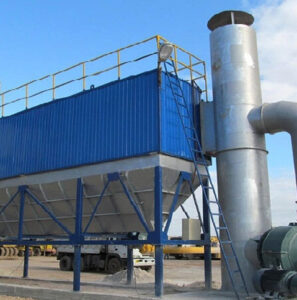
Dust Collector Pressure Drop: Causes, Warning Signs and How to Fix It
A dust collector problem can begin with a climbing differential…
Read More →

The most expensive filter bag is not always the one with the highest price. Sometimes the cheaper bag blinds early, drives pressure upward, demands more cleaning, and forces an unplanned shutdown.
That is why choosing a filter bag material should never begin with a catalogue. It should begin inside your process: What temperature does the bag actually see? Is moisture present? What chemicals are in the gas stream? Is the dust abrasive, sticky, oily, or fine? How aggressively is the collector cleaned?
Polyester, PPS, PTFE, and aramid can all work. The right choice survives your combination of heat, chemistry, dust, and mechanical stress without making filtration unnecessarily expensive.
Before comparing materials, look at what is happening to your current bags.
Are they shrinking? Tearing near the cage? Becoming stiff? Blinding with sticky dust? Developing holes? Showing chemical attack? Requiring increasingly frequent pulse cleaning?
These symptoms matter because two plants operating at the same temperature may need completely different media.
A hot, dry, abrasive process may point toward aramid. A hot stream containing acids and moisture may make PPS or PTFE more suitable. A moderate, dry application may not need premium media at all; polyester may deliver the best lifecycle value.
The goal is not to buy the “strongest” material. It is to remove the dominant failure mechanism.
Polyester is often the starting point for general industrial dust collection because it combines good mechanical strength, abrasion resistance, availability, and economical pricing.
For dry, moderate-temperature processes, polyester can be an efficient filter bag material for cement handling, woodworking, minerals, food powders, and general manufacturing dust.
Its limitation appears when heat and moisture occur together. Polyester can lose performance through hydrolysis in warm, humid conditions. Aggressive chemical exposure can also narrow its suitability.
Choose polyester when conditions are stable, moderate, and dry. Do not upgrade simply because a premium fibre sounds better. If polyester fits the process, it can provide excellent value.
PPS, often known commercially as Ryton, moves the decision into more demanding territory.
It is commonly considered for boilers, power generation, incineration, and chemical processing where acids, alkalis, or moisture make polyester less dependable. PPS also supports higher operating temperatures.
However, PPS has an important qualification: oxygen exposure and temperature must be evaluated together. A material that looks suitable on a temperature chart can deteriorate faster when oxidising conditions are severe.
PPS therefore works best when the full flue-gas profile is known, not when procurement is working from temperature alone.
Aramid is a strong candidate when the process is hot, dry, and mechanically demanding. Its combination of temperature capability, strength, and abrasion resistance makes it useful in areas such as asphalt production, cement, foundries, lime, metal processing, and other high-temperature dust applications.
Aramid is not automatically best whenever heat rises. Moisture and aggressive acids can change the decision. If the process crosses the dew point or faces challenging chemistry, another filter bag material may last longer.
Think of aramid as a specialist for thermal and mechanical stress rather than a universal high-temperature answer.
PTFE becomes attractive when several difficult conditions occur at once: high heat, corrosive chemistry, moisture, fine particulate, or problematic dust release.
ClipOn PTFE filter bags are designed for demanding industrial environments and can support continuous temperatures up to 260°C, subject to the complete operating specification.
PTFE provides strong resistance to acids, alkalis, and many aggressive chemicals. Its low-friction, hydrophobic characteristics can help where dust adhesion and moisture create persistent problems.
Its higher purchase cost means PTFE should solve a real operating risk. Specifying it for a mild application may add cost without meaningful benefit.
One distinction buyers should clarify is whether “PTFE” means 100% PTFE felt or a PTFE membrane applied to another substrate. These constructions are not interchangeable and can have different performance, temperature, and cost implications.
Before requesting a quotation, document five things: continuous and peak temperature, gas chemistry, moisture and dew-point behaviour, dust characteristics, and cleaning method.
A strong recommendation should cover bag dimensions, cage condition, seam construction, surface finish, differential pressure, air-to-cloth ratio, and emission requirements. The fibre matters, but the complete bag assembly determines reliability.
The best filter bag material is the one that keeps filtration stable for the lowest sensible lifecycle cost.
Consider replacement frequency, maintenance labour, compressed-air demand, fan energy, production downtime, disposal, and the consequences of premature failure alongside the purchase price.
ClipOn offers polyester, PPS, aramid, PTFE, and other filter media with multiple construction and finish options. Rather than selecting a material name alone, share your process temperature, gas composition, dust behaviour, collector design, and current filtration problem.
That information turns a filter bag quotation into an engineering decision and makes it easier to choose a material that performs after installation, not merely on the specification.
A dust collector problem can begin with a climbing differential…
Read More →
What happens when filtration engineers, boiler operators, and maintenance leaders…
Read More →
The hottest filtration story of 2026 is not a new…
Read More →