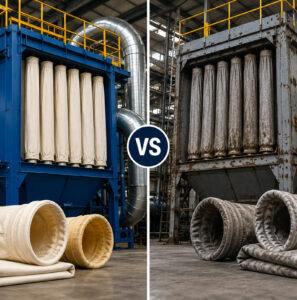
High Temperature Filter Bags vs Traditional Methods: Which Performs Better?
At 2 a.m., when a boiler temperature climbs and the…
Read More →

The first warning was not smoke, an alarm, or a shutdown. It was a pattern hiding in data: pressure climbed after every pulse, startup temperatures swung unpredictably, and installed bags were already showing wear. This high temperature filter bags case study follows a plant that stopped treating repeated replacement as maintenance and started treating it as an investigation. By tracing heat, moisture, dust, cages, and cleaning together, the team uncovered why the baghouse was struggling and how a filtration campaign changed outcomes.
Case note: The plant, readings, and timeline are an educational composite, not a published customer result.
The fictional plant operated a biomass-fired boiler feeding a pulse-jet baghouse. Gas temperature averaged 185°C, but startup peaks reached 225°C. Differential pressure had risen from an illustrative 120 mmWG to 175 mmWG, cleaning frequency had nearly doubled, and several bags showed brittle patches and vertical wear.
Maintenance initially blamed “poor bag quality.” The campaign leader resisted. Brittle areas suggested thermal or chemical stress; straight wear lines pointed toward cage contact; rising pressure hinted at poor cake release, condensation, airflow, or cleaning. One symptom could not explain the system.
The fastest action was reordering the existing bags. Instead, purchasing paused while operations assembled a process record.
The team logged continuous temperature, peak duration, oxygen, moisture, fuel changes, dust loading, differential pressure, pulse frequency, air pressure, and shutdown behaviour. Every failed bag was marked by compartment and position.
This became the first of several high temperature filter bags tips: preserve evidence before replacement. Once damaged bags are discarded and data is averaged, the failure story becomes harder to reconstruct.
The team laid six removed bags beside their cages. Three had hardened inlet-side areas. Two showed polishing along cage wires. One had a damaged cuff that allowed bypass.
Inspection found rough cage welds and slight distortion. The sharpest pressure increases followed cool startups after weekend shutdowns. The plant had treated the problem as one material failure, but evidence indicated three interacting causes: temperature excursions, possible condensation, and mechanical abrasion.
The original specification listed only diameter, length, and a generic heat-resistant fibre. The revision described the operating environment.
ClipOn lists aramid around 204°C and fiberglass, P84, and PTFE options up to 260°C for suitable boiler applications. These figures are selection boundaries, not automatic approvals; chemistry, moisture, abrasion, finishes, and exposure duration still matter.
The team shortlisted two constructions and asked: What happens during a 225°C spike? How does each fibre react to acidic moisture? Will the surface release this dust? Can it tolerate existing pulse energy?
Instead of replacing bags alone, the campaign specified smoother cages, corrected geometry, compatible diameter, and inspected welds. ClipOn offers carbon-steel, galvanized-steel, and stainless-steel cages, with custom shapes and finishes designed to support bags and reduce damaging contact.
This addressed a blind spot. Premium media cannot last while rubbing against a bent or rough support through thousands of cleaning cycles.
Rather than changing the entire baghouse, the plant installed an illustrative trial set in one compartment. The team recorded photographs, bag positions, cage numbers, initial differential pressure, and cleaning settings.
For thirty days, operators resisted increasing pulse pressure whenever readings moved. They checked hopper discharge, valves, temperature, airflow, and moisture first. The trial provided a clean comparison with unchanged compartments.
The campaign introduced startup rules to keep dusty gas away from cold media. Alarms were separated into warning, continuous-limit, and emergency-spike levels. Maintenance began trending differential pressure rather than recording one daily number.
These high temperature filter bags best practices changed behaviour without costly automation. Operators could connect pressure rises with startup events, pulse-valve faults, production changes, or temperature excursions.
After ninety days, the trial compartment showed steadier pressure, fewer emergency cleaning interventions, and no repeated cage-line wear. These are illustrative outcomes, not ClipOn performance claims. The important result was diagnostic confidence: the plant understood which changes helped and what required monitoring.
The campaign avoided a premature victory. Ninety days could demonstrate stability, not final bag life. Inspections were scheduled at three, six, and twelve months, with removed samples retained for comparison.
A high-temperature bag campaign succeeds by converting symptoms into a controlled specification. The sequence matters: collect data, map failures, separate thermal, chemical, and mechanical causes, select media and finishes, inspect cages, control installation, and monitor trends.
For recurring wear, unstable pressure, or hot corrosive gas, explore ClipOn’s dust collector filter bags and cages. Share temperatures, dust behaviour, gas chemistry, drawings, and failed-bag evidence so the recommended solution begins with the application—not a catalogue guess.
That is how a replacement becomes a measurable filtration improvement campaign for the plant. This prevents the same failure recurring again later.
At 2 a.m., when a boiler temperature climbs and the…
Read More →
Choosing among leading bag filter suppliers is not simply a…
Read More →
High-temperature filter bags rarely fail because of one dramatic event.…
Read More →